

Continuous operation instead of
living room use – the true service life of professional displays
When a display fails after many years of use, customers often feel uneasy:
“The device is only ten years old—it should have lasted longer.”
The comparison is almost automatically made with the TV in their own living room. A TV often runs reliably for many years—so why not a display in a supermarket, shop window, or showroom?
This is precisely where the error in thinking lies. A professional display in continuous commercial operation works under completely different conditions than a home device. The strain it experiences in just a few years often corresponds to several decades of private use.
A look at the figures, a clear analogy, and some technical background information show why a failure after ten years is not a quality problem—but the result of enormous performance.
The bare figures – what operating time really means
Electronics do not age primarily according to the calendar date, but rather according to operating hours, temperature, and load. That is why it is worth taking a sober look at actual usage first
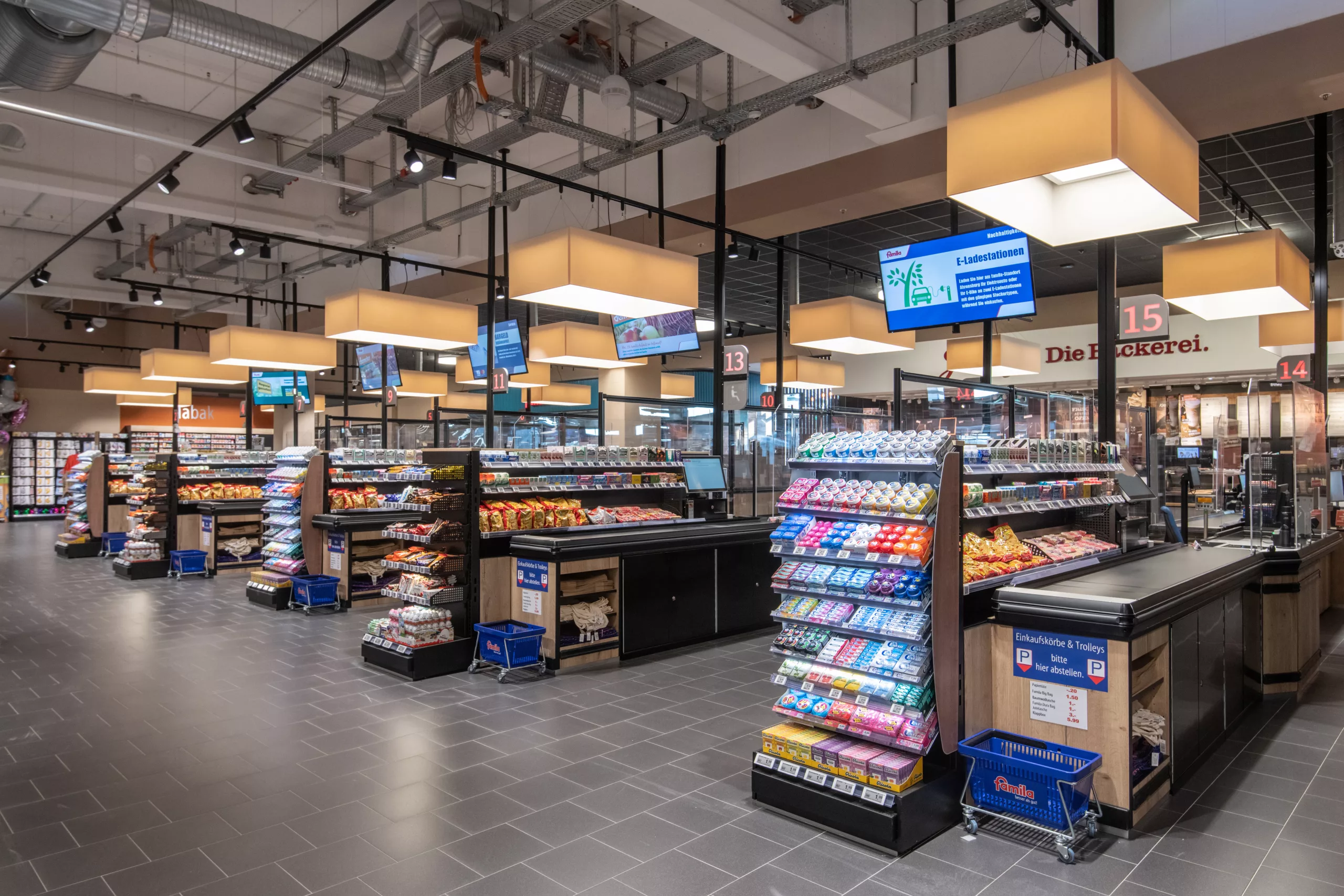
The professional display in the grocery store
Typical use in retail:
- Daily operating time: approx. 15 hours (7:00 a.m.–10:00 p.m.)
- Operating days: 6 days per week
- Hours per week: approx. 90 hours
- Hours per year: approx. 4,680 hours
- Total after 10 years: approx. 46,800 operating hours
The display thus runs almost continuously – week after week, year after year.
The living room TV as a comparison
Even with a rather high assumption in a private setting:
- Daily use: approx. 4 hours
- Days of operation: 7 days per week
- Hours per week: 28 hours
- Hours per year: approx. 1,460 hours
- Total after 10 years: around 14,600 operating hours
Many households are even significantly below this.

The eye-opening effect
In ten years, the professional display has achieved more than three times the operating time of a living room TV—a factor of around 3.2.
Even more impressive:
To reach around 46,800 hours, a private television would have to be operated for four hours a day for around 32 years.
A supermarket display therefore does the work of over three decades of home use in a single decade.
The car analogy – technology explained in simple terms
The figures are correct – but only a comparison makes them tangible.
The living room TV can be compared to a car that is driven comfortably to work every day. After ten years, it may have clocked up 120,000 to 150,000 kilometers. The vehicle is worn in, but still in perfect technical condition.
The professional display is more like a taxi that operates in shifts. It runs almost continuously, covers long distances every day, and after ten years has clocked up several hundred thousand kilometers.
When the engine or transmission of such a taxi wears out, no one talks about a defect—it is the logical consequence of intensive use.
The same applies to displays: the panel, backlighting, and power supply are highly stressed components. It is normal for them to reach the end of their service life after an extremely high number of operating hours—and this is technically taken into account.
Why use in grocery stores and supermarkets is particularly stressful
In addition to pure operating time, commercial environments involve additional stress factors that home devices do not encounter.
High brightness and backlight wear
In living rooms, televisions are usually used in the evening, with moderate room lighting and reduced brightness.
In supermarkets, displays have to compete with strong artificial light. Brightness is often permanently set at 80 to 100 percent. This means significantly higher thermal stress for the LEDs in the backlighting—and thus faster aging.
Continuous operation and heat
At home, a TV runs for a few hours and then cools down for many hours.
In stores, the device often runs for 15 hours at a time, sometimes in confined installation situations with limited air circulation. Heat is the biggest accelerator of aging processes in electronics – especially in capacitors in the power supply.
Static content
Prices, logos, or fixed layouts are often displayed for long periods of time in digital signage operations. This puts more strain on individual pixels than others. Depending on the panel technology, this can lead to uneven aging or visible burn-in effects.
This is also not a defect, but a typical consequence of intensive use.

Properly assessing service life
Manufacturers often specify typical service lives of around 30,000 to 50,000 hours for backlights and panels – usually based on a defined residual brightness.
A display that is replaced after around 47,000 operating hours is therefore well within its intended service life range. It has fully fulfilled its technical design.
Under real-world conditions with high brightness, continuous operation, and thermal stress, this is even a sign of very robust quality.
Change of perspective – from “broken” to “top performance”
The key point is the change of perspective:
A professional display is not a living room device, but an industrial work tool. It is built to function reliably for many years under heavy load – and that is exactly what it has done.
Ten years of continuous operation in retail equates to more than three decades of private use. The fact that a device is replaced after this period is not a sign of weakness, but the result of its performance.
For operators, this means planning security: life cycles can be calculated realistically, investments can be evaluated soundly, and modernizations can be prepared strategically – instead of being perceived as unexpected defects.
Conclusion
A professional display in continuous operation works under completely different conditions than a TV in the living room. The combination of extreme operating hours, high brightness, continuous thermal stress, and static content inevitably leads to higher wear and tear.
If a display needs to be replaced after around ten years and almost 47,000 operating hours, it has not failed to meet its life goal—it has achieved it precisely.
Or to put it another way:
It is not the time on the calendar that determines quality, but performance in operation.
Those who understand these relationships make better decisions when investing in, maintaining, and renewing digital signage systems—technically sound, economically sensible, and without false expectations.