

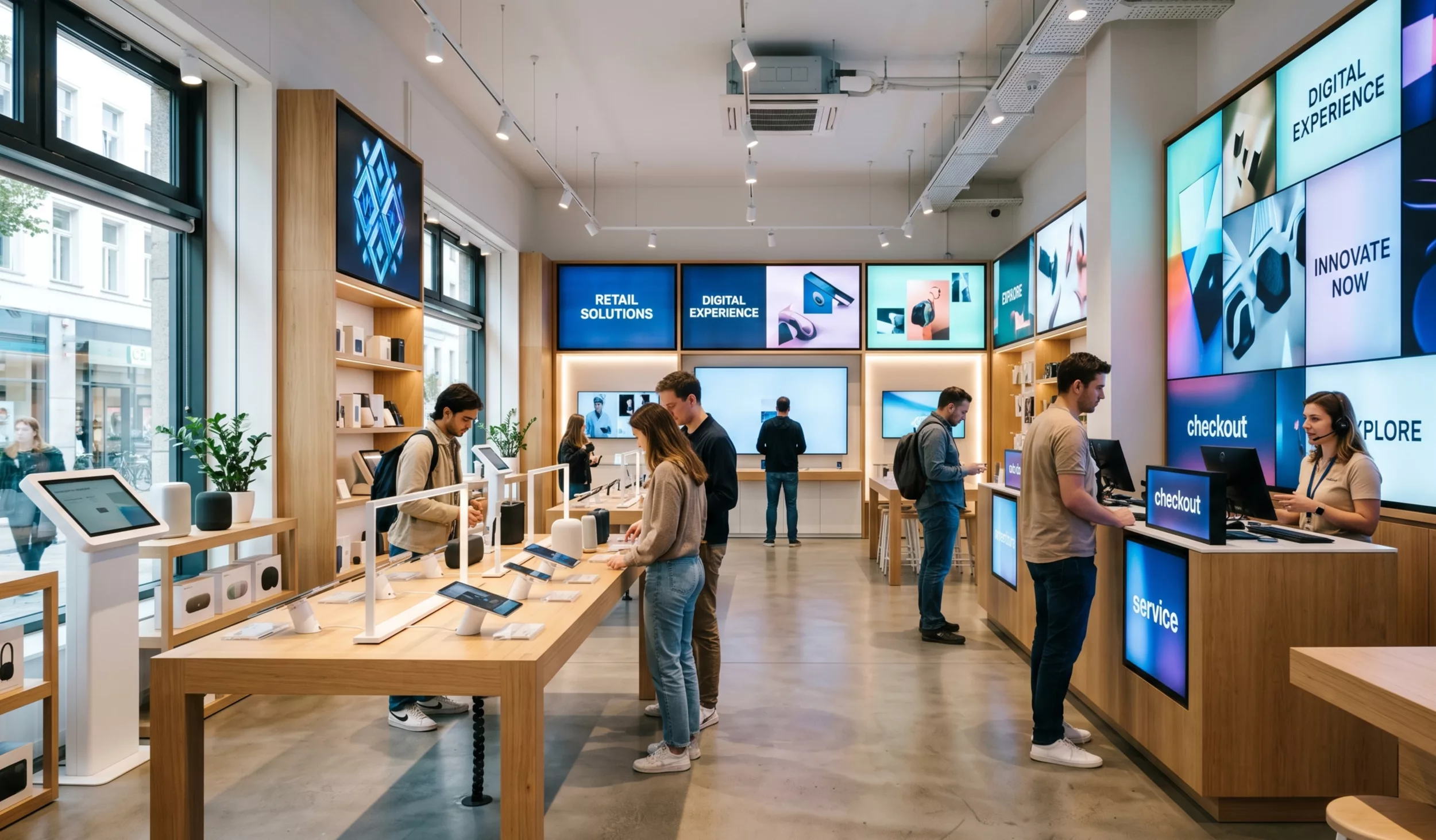
End the POS Nightmare: How to Digitally Manage Your Retail Network
Inconsistent brand messaging is every marketing executive’s nightmare. While headquarters invests millions in high-end campaigns, execution at the POS often falls short due to the realities of the retail environment. Learn how you can regain control of your brand with intelligent cloud technology—globally and in real time.
Imagine your team develops a groundbreaking, emotional campaign. The visuals are perfect, the message hits home. But when the customer walks into a retail partner’s store, they’re met with a faded cardboard display relic from the previous year. The “brand break” is complete, and the painstakingly crafted customer journey comes to an abrupt halt.
For marketing decision-makers at premium brands, this is one of the biggest challenges: How do you ensure that the brand message reaches thousands of locations worldwide exactly as it was conceived at headquarters?
The Problem: The “Chinese Whispers Effect” in Retail
In traditional sales structures, marketing departments often lose control as soon as campaign assets leave headquarters. Local retailers usually have neither the time nor the technical infrastructure to implement complex campaigns on a daily basis. The result is “visual chaos” that undermines brand authority and squanders valuable conversion potential.
A static point of sale is simply no longer competitive in the digital age. It doesn’t respond to trends, the weather, or—certainly not—the global marketing strategy in real time.
Best Practice: STIHL’s Global Standard
STIHL’s global rollout proves that this transformation works even within highly complex dealer networks. As a global premium brand, STIHL faced the challenge of technologically modernizing thousands of specialty dealers without undermining the local identity of its partners.
By implementing the cloud-based signage solution vir2cloud®, STIHL was able to bridge the gap between headquarters and the sales floor. The result: a globally consistent brand image that reflects the innovative strength of the products. Headquarters manages global campaigns, while the system ensures that every screen always displays the most up-to-date and relevant content.

The Solution: The Digital Extension of Headquarters
The answer to this fragmentation is not more control through staff, but through technology. Modern digital solutions serve as a technological link between strategy and the retail floor.
- Centralized content control: Campaigns are rolled out globally at the push of a button. No logistics for print materials, no misdeliveries.
- Effortless local relevance: The retailer becomes a brand ambassador without any operational burden. They can enter local offers into predefined templates while the brand design remains intact.
- Dynamic emotional engagement: Instead of static signs, high-quality video content and interactive elements capture attention and draw customers deeper into the brand world.
Why Marketing Decision-Makers Need to Rethink Their Approach Now
The point of sale is no longer just the place where transactions take place, but the most important touchpoint for the brand experience. Those who rely on “analog” methods here will fall behind in meeting customers’ digital expectations.
The benefits at a glance:
- Brand Consistency: 100% control over the visual identity worldwide.
- Time-to-Market: Launch campaigns in seconds instead of weeks.
- Reduced burden on partners: Maximum support for retailers with minimal effort required from the partner.
- Measurability: Transparency regarding which content is displayed where and when.

Conclusion
POS digitization is not just a technical gimmick, but a strategic necessity for modern brand management. By bridging the gap between headquarters and the sales floor, companies can build customer trust and strengthen their market position in the long term.
Put an end to the nightmare at the point of sale!
Do you want to regain full control over your global campaigns—just like STIHL? Let us show you how easy digital brand management is in practice.